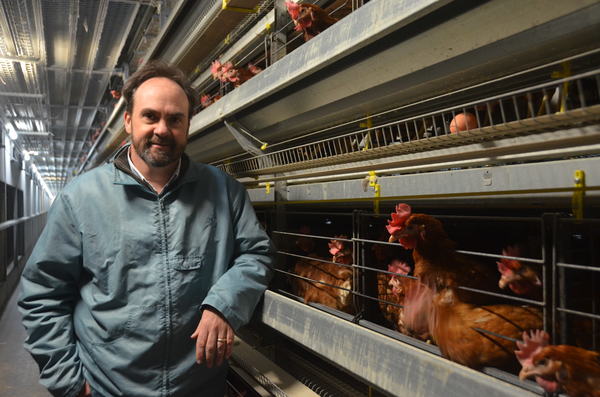
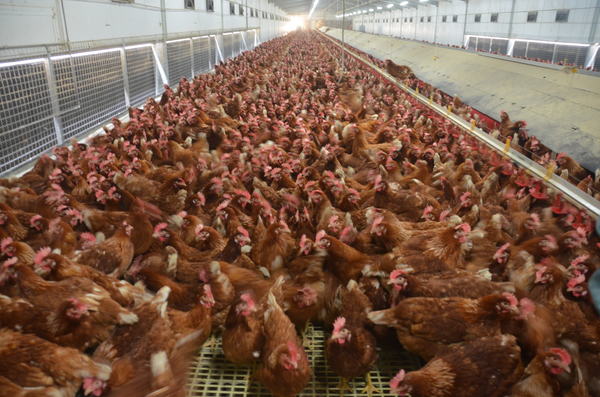
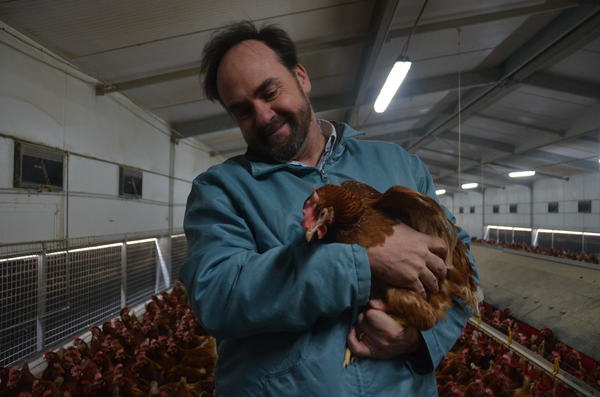
The chooks at Tamarix Egg Farm in Bangholme lay about 70,000 eggs each day, says owner Andrew Postregna. He shows Casey Neill through the cage and barn sheds.
“Farmers want to look after their hens. We want a good healthy hen.”
ANDREW Postregna was born into egg farming.
“I started working with my dad when I was five, six years old in the sheds,” he said.
“Ever since I’ve been doing it, pretty much.
“My dad came over from Northern Italy in 1952 and just started working.
“He worked on the trams and the buses and the train lines in Victoria.
“He started the original business in Chandler Road in Keysborough.
“I think they leased that farm.
“They ended up buying the one on Chapel Road in Keysborough.
“That’s where they built all the sheds.
“In that time he brought his brothers over and his mum and dad.
“They all got together and built up the business.
“Later the brothers took their own paths.
“My dad continued with that farm and then he purchased this property (on Frankston-Dandenong Road in Bangholme) in the mid-‘70s.
“He built the first sheds in the early to mid-‘80s here.
“Apparently a lot of people couldn’t get chickens back in those days.
“They couldn’t keep up with demand.
“Back then they used to eat the broiler hens. They were really popular.
“As the meat industry came on, they sold less and less of the broiler hens so the eggs became the main seller.
“Eggs is the core business.”
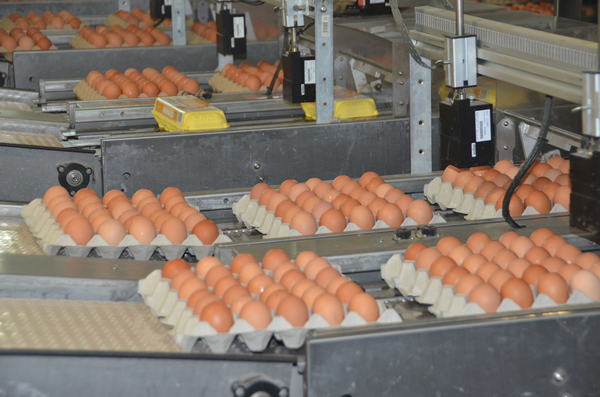
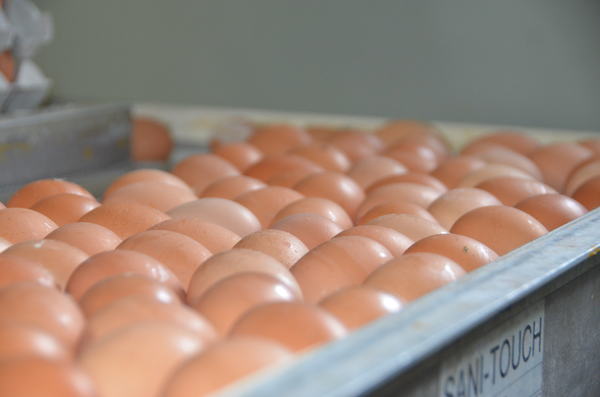
On averaged the farm produces about 70,000 eggs a day.
“You have to take into consideration when we change flocks,” he said.
“Here we have six different flocks at the moment.
“That’s just to keep a consistent flow of eggs.
“You have different age groups.
“When they’re young they weigh a small egg, as they get older they get bigger and bigger and bigger.
“You keep on rotating the flocks.
“You can keep a consistent number of eggs.”
The hens generally lay for about a year and a half.
“They start laying at about 16 weeks of age,” Andrew said.
“We keep them to about 80 weeks.
“If you go further than that the shells become too weak.
“The chickens get picked up and they get processed.
“A lot of the Asian market still like the broiler hens.
“They export some of them.”
There are generally about 85,000 hens on the farm at any given time.
“We also grow pullets as well. We grow about 18,000 here,” Andrew said.
“We have other farms, too.
“We grow them from one day old to 16 weeks.
“At 16 weeks we transfer them into the sheds.
“We use two breeds, the hy-line brown and the lohmann brown.
“The hy-line tend to be a lot calmer bird, very placid.
“The lohmann tend to be more flighty.
“The lohmann have a more consistent egg right through.
“The hy-line don’t have as much of a consistent egg.”
There are three sheds on the farm.
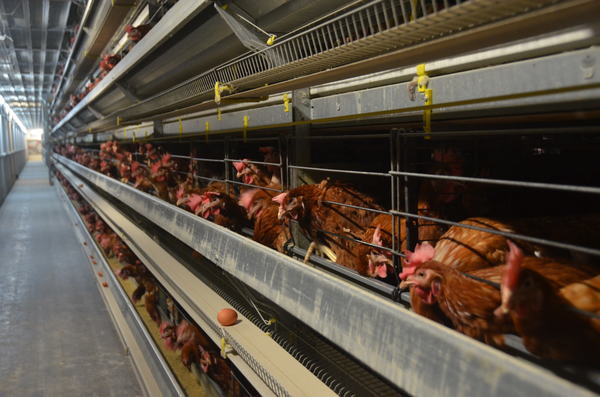
“Two of them are caged and one of them is barn, or cage-free,” he said.
“They’re all environmentally-controlled sheds.
“The sheds are kept at a very constant temperature of about 20 degrees throughout the year.
“That’s an optimal temperature for the chooks.”
Andrew went to Europe in the early to mid-2000s to see what chicken systems the farmers there were using.
“In 2008 we had to upgrade our old sheds to meet the new regulations,” he said.
“I went over there to see what I was going to do – whether I was going to go cage, barn, free range.
“I went to see all three systems.
“Free range was taking off over in Europe a bit back then.
“I went to a free range farm and I didn’t like it at all.
“It was coming into winter and all the chickens were outside.
“The paddocks were all mud and they were all dirty. They step on the eggs sometimes.
“At the cage farm I couldn’t believe how clean and well-run it was.
“I made up my mind then to do cages.
“That’s what influenced me. I built the two cage sheds.”
Meanwhile, the free-range movement had started in Australia.
“I decided to do a barn shed here because it was in-between free range and cage,” he said.
“Over in Europe that’s the biggest type of egg they sell.
“The market’s heading that way (towards free range).
“That’s what people are demanding.
“Because consumers are demanding it, you have to supply what people want.”
But free range causes problems for farmers and chooks.
“When you go back to the ‘40s, ‘50s, when caged farming was introduced, the whole reason was to stop the diseases from birds being outside,” he said.
“Cage eggs still make up over 50 per cent of all the eggs in Australia.
“I noticed in England the caged system went down to 40 per cent but it turned around and it’s back up to almost 60 per cent again.
“Personally I think we need all three systems.
“A cage is a really efficient way of producing eggs and it’s affordable for a lot of people.
“You’ve got a continual consistent supply.
“With the other systems you have problems.
“When it gets cold they tend to drop in production, so there’s less eggs.
“When you come into spring there’ll be a big spring flush.
“We have such good animal welfare here in Australia.
“They can be assured that they’re getting a good product and a good animal welfare egg.
“The industry gets a lot of attention.
“The majority of farmers do the right thing. They want to look after their hens.
“We want a good healthy hen.
“If they’re upset they won’t lay.”
He said that his sheds offered a stable environment and created a stable supply. They also keep the chickens safe from diseases and bugs, he said.
“There are a lot more variables in the free range than what there are in the cage system,” he said.
“We’ll see what happens down the track.
“I think Australia, we’re in a really good position here in Australia because we’re pretty much disease-free in regards to avian influenza.
“That’s a really big benefit to our country.
“We’re seen as a clean, green country.
“We really do need to keep our biosecurity up.
“With free range, biosecurity’s a lot harder than it is with the barn and the caged.
“It’s a bit of a concern for me and for the whole industry.”
Despite all the time he’s spent with them, Andrew still finds the hens interesting.
“A small bird like that can produce like a vitamin capsule, really,” he said.
“It intrigues me, it really does.
“It can produce an egg a day, basically.
“It’s really healthy, it’s got all the vitamins, minerals, protein …
“I love eggs. Eggs are so versatile.
“They’re a really good protein source for people as well.
“Because meat’s becoming expensive people are buying eggs.
He said each person ate about 230 eggs each year and that the egg’s popularity had increased over the past 10 years.
“They’re a really healthy alternative to meat as well.
“I have them at least three or four times a week.
An on-site cafe serves up egg dishes on the farm.
“I think this was built in 2010. That day’s eggs, we bring them up every day,” he said.
“They get to choose between the cage and the barn.
“My favourite is the gourmet scramble.”
Tamarix’s main customers are Melbourne cafes, restaurants, bakeries and small supermarkets.
“We don’t deal with the big supermarkets at all,” he said.
“We have our own packaging.
“The boxes that we put the eggs into have got our brand on it, as well as the dozen packs.
“We also market them as barn or caged.”
Tamarix has its own vans and truck and employs about 20 people.
“We do everything as much as we can in-house,” he said.
“I employ a lot of local people.
“It’s a pretty tight-knit team.
“They’re enthusiastic about what they do and how they do it.”