Walk into an office and you can tell (often within seconds) what it feels like to work in that space. Some offices make you immediately feel comfortable — the lighting is gentle, the plan flows logically and you know, intuitively, where to go. Others make you feel anxious or disorientated, even if they are beautifully decorated. Rarely is there one dramatic design issue at fault. More often it’s the intangible combination of the space and how people can move within it, alongside the atmosphere that is created.
For many organisations this comes to the surface in day-to-day moments. Clients hesitantly lingering in the doorway, staff congregating everywhere but a strangely arranged open-plan office or meeting rooms that still feel slightly uncomfortable to sit in. This is rarely an issue of poor design, more a case of the energy being out of alignment. Spaces which, on paper, look slick and professional but in practice don’t quite meet the needs of how we work, communicate and unwind throughout the day.
This is where office feng shui can help. Modern feng shui is all about creating environments which are balanced, welcoming and functional. From first impressions at the reception desk through to the flow of the workspaces beyond, let’s dive into how mindful design decisions can make a difference in professional office settings.
First Impressions Matter: Designing a Welcoming Office Entrance
When businesses invest in high-quality reception desks Melbourne offices rely on, it’s often the carefully considered, softer elements that create the best foundation for setting the tone from the moment a visitor steps through the door.
Feng shui practitioners call the reception area the “mouth of chi”, where energy enters and flows around a space. Translated into practical, everyday terms this means the entrance area to an office should feel open, intuitive and calming. When a visitor can see where to go and who to speak to from the moment they walk in, there’s less friction, which can make the whole office feel easier to navigate.
The position of the desk itself is one of the most important factors in creating this feeling. A reception desk that’s directly in front of the door, or at an angle that blocks the entry, creates tension. In contrast, one that’s clearly visible without being intimidating helps ground and welcome visitors. Scale also has an impact, with a desk that’s disproportionately large or small both changing the energy of a space. A large desk can feel defensive or off-putting, while a small one can be perceived as lacking professionalism or gravitas.
Material and finish choices will also impact how inviting and approachable a space feels. Natural textures and finishes, warm timber tones and rounded shapes tend to make a space feel more welcoming than cold, shiny surfaces or severe angles. Paired with smart lighting and unobstructed sightlines, these details can help create a reception that’s both professional and calming. Setting a positive emotional and energetic baseline before any conversation even begins.
Balancing Flow and Function Throughout the Workplace
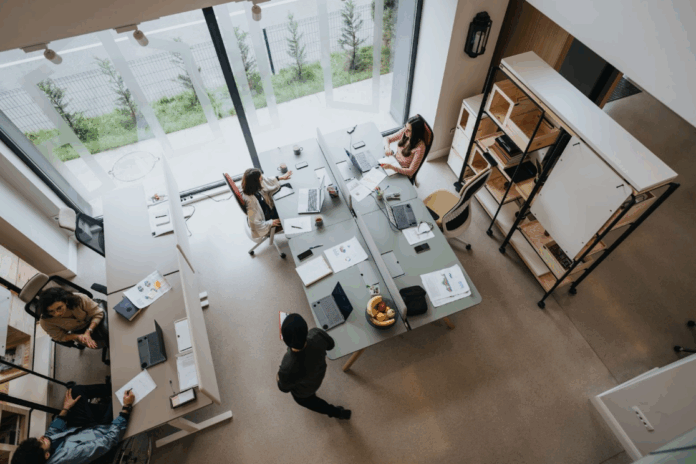
The flow throughout the rest of the workplace should work with the way people actually operate. Instead of strict guidelines, good feng shui is flexible and promotes a sense of flow that allows for movement, collaboration and concentration to occur without friction or hindrance. Clear pathways and purposeful spaces enable staff to use less mental effort to interact with their surroundings, and as a result, to dedicate more of their attention to their work.
A sense of flow also means that there’s a good balance between the function of various zones. Open, intuitive floorplans benefit high-traffic areas, while spaces designed for focus and calm benefit from enclosure and stability. The right layout of a workplace both aligns with the natural ebb and flow of daily business and ensures smoother work processes without the small annoyances that subtly chip away at productivity.
Furniture Placement That Encourages Productivity and Calm
Believe it or not, furniture arrangement is one of the biggest influencers of how calm and focused an office can feel. Having desks with a clear view of entrances helps create a feeling of control and calm, and avoiding alignment of workstations with doorways prevents constant visual distraction. This considered placement makes it easier for employees to get comfortable with their surroundings and stay focused for longer.
Storage, seating, and workstations should also be well-balanced for ease of access and logical movement. When staff members aren’t constantly adjusting their posture, stretching to reach something or reorganising in unnecessarily awkward layouts, it makes for better time management and fewer distractions and disruptions.
Material Choices That Promote Warmth and Professionalism
Materials are perhaps the element of office design that most linger in a visitor’s or employee’s memory. You might not always be able to articulate why a room ‘felt’ different to others, but subconsciously, those small sensory details matter, contributing to the experience of professionalism and comfort in an office. Materials that are carefully considered help to make a space look well-loved and maintained without having to be said.
Warmth in a professional setting doesn’t necessarily mean cosy or informal. Rather, it’s the lack of cold, hard or over-sanitised surfaces. Offices with too many glossy, shiny or high-contrast finishes can look polished and impressive at first, but actually be fatiguing and exhausting to work in. Tactile, natural materials and finishes help to break up and soften a space, helping staff and visitors to relax, think clearly and behave more naturally with others.
Natural Finishes, Textures and Colour Psychology
Natural finishes help to keep professional spaces balanced. Visual texture in timber grains, matte laminates or lightly textured fabrics helps to add depth to a space without visually cluttering it. These finishes also age gracefully, too, with marks and signs of wear adding character over time, instead of detracting from it, which reinforces the sense of stability and trust within the space.
Colour has a similar effect. Muted, earthy tones and warm neutral colour palettes generally create a more calm, blank canvas for supporting focus, with bolder, deeper accent colours adding confidence and definition if used in moderation. Texture, too, helps to give these palettes life, with layers of material adding subtle interest without being distracting. Together, these carefully selected finishes, textures and colour choices help to give an office a considered and well-loved feel.
Creating Harmony in Shared and Private Spaces
Every office contains both shared and private spaces. Shared spaces are where energy and interaction occur. Ideas are shared, decisions are made, and relationships are fostered. Private spaces are where concentration occurs. Focus is enhanced, confidence is nurtured and leadership is cultivated.
The success of both is dependent on rhythm. A harmony that is derived from an understanding that they shouldn’t feel like interchangeable parts of the office. Instead, the two must be defined in a way that creates distinct boundaries without impeding one another’s purpose.
Instinctively, well-defined shared and private spaces will cue employees to make small but significant adjustments in their behaviours, which, in turn, support each space’s different needs. The volume of voices, their posture, and the type of energy they exhibit are all clues which will differ depending on if they are in a private or shared area, avoiding friction and reducing the need for unspoken negotiations and adjustments.
Teams will intuitively move from one area to another throughout the day without disruption or hesitation, operating with a sense of fluidity instead of making numerous decisions about where and how work should take place.
Meeting Rooms, Workstations and Executive Offices
Meeting rooms should have an inherent sense of neutrality and balance. Comfortable seating without any single seat dominating the room or layout which feels inclusive, promotes communication and allows discussions to flow more easily. The right table sizes, proportions and acoustic control all help to ensure meetings feel productive, rather than exhausting, so teams are being efficient and effective without feeling like they are either rushing or lingering too long.
Workstations should offer consistency. Predictable workstation layouts, storage and amount of personal space all enable employees to slip easily into work mode as soon as they walk into the office each day. Executive offices often call for a different dynamic. An area which communicates authority but also accessibility. It is far more likely to promote both confidence and grounded decision-making if the space doesn’t feel imposing.
Practical Feng Shui Tips for Modern Offices
Feng shui doesn’t have to be about big-ticket renovations or over-the-top style. On the contrary, it’s often the little things, the tweaks that make your space more comfortable and functional on a day-to-day basis, rather than more Instagram-worthy, that are most worthwhile. Signs that your space could use some attention include areas that feel awkward or underutilised or that consistently draw avoidance. You might even feel intuitively that a design element just ‘doesn’t feel right’, even if you struggle to explain why.
Fixes can include anything that brightens your space, reduces visual chaos, streamlines navigation or better positions frequently used items. Any changes that make your space feel lighter and easier to move through will support clearer thinking and better interactions. If your space has a high-energy feel, you can also help to mitigate negative effects by incorporating elements that bring a sense of the natural world, through plants, natural light or biomorphic shapes. These elements also work well in more serious office settings to reduce stress without sacrificing a sense of gravitas.
It also helps if your office feels pulled together rather than cobbled together. Harmonious spaces that feel carefully curated, even down to furniture, finishes and layout details, support feelings of confidence and trust from the inside out. This kind of subtle but solid grounding is, after all, what underpins any first impression, which is always an ongoing, cumulative and largely unspoken factor in our relationships and performance in business.
Designing Offices That Feel Good to Work In
At the heart of good office feng shui is the recognition that spaces exist to serve people, not the other way around. When an office feels intuitive, comfortable and carefully considered, it’s easier to be present, work together and show up each day. These spaces don’t get in the way or require attention. They simply function as they should, quietly and in the background.
Designing a space that’s easy to use isn’t about checking off boxes or trying to keep up with trends. It’s about being aware of how a space feels and making decisions that allow people to feel welcome, supported and relaxed. When those three things are in place, what you end up with is a space that not only looks professional, but one that also functions for the people within it.