Pakenham is a suburb on the up-and-up. A mixture of families and young professionals call the area home, and more keep popping up every day as the population surges, rising 10% since the 2021 census. This keen workforce, coupled with industrial and commercial investment, has made Pekanham one of Victoria’s most desirable investment destinations.
Despite its acres of green fields, thriving logistics centres and abundant retail opportunities, there still exist, as in any place, threats to the safety and security of operations. Crimes such as theft, property damage, and breaking and entering are becoming more common. Though these figures are still on the lower end of the Australian average, complacency only exposes your organisation to more risk.
The risks in numbers
Cardina experienced a 25.5% increase in offences over the last year, with Pakenham leading among suburbs. This rise included a sharp climb in business-related offences, including vandalism and burglary. Public and commercial spaces arealso prime targets for vehicle theft, the most common crime in the area, solidifying the need for internal and external countermeasures that protect businesses, workers and their possessions.
Companies spend billions annually trying to cover the cost of shrinkage and replace lost goods, but that’s only a part of the equation. 146,000 injury claims were filed last year alone, with each incident resulting in 7 weeks of lost work and tens of thousands of dollars in financial compensation. These two factors, crime and supervision, are of particular concern in industrial and retail sites, where expensive stock, heavy loads and hazardous machinery are a daily reality of the job.
The limitations of standard observation
CCTV networks play an important role in both deterring crime and investigating safety incidents. A small handful of cameras can capture hundreds of hours of footage every day, the vast majority of which will never be reviewed unless there’s an explicit reason to. Thanks to this wealth of useless videos, it can take security teams hours of labour to search through recordings for relevant information, and this only helps them learn what has happened after the fact.
Alarms also suffer from inoptimisation. Research shows that around 95% of domestic alarm calls are false, which has led to police ignoring them unless they can be verified. Security teams experience the same phenomenon, where alert fatigue leads them to disregard real concerns. The solution to both of these shortcomings lies in modern systems’ ability to interpret data from multiple sources.
Improving oversight in retail and industrial sites
Though a grocery store and a warehouse are worlds apart in terms of their floor plans, they both face similar logistical challenges when it comes to site safety:
- Blindspots
Where equipment or storage blocks the camera view, or where areas are left entirely unobserved.
- Indoor and outdoor spaces
Points of entry, carparks and loading bays require attention as much as high-value shop floors and back offices.
- Out-of-hours activity
Retail stores are often left vacant overnight, whereas industrial sites may operate with reduced staff, leaving both vulnerable to late-night or early-morning attacks.
- Lone workers
Both industries involve solo tasks, making safety harder to guarantee.
Commercial security systems, built on a foundation of smart cameras and IoT sensors, address these issues by turning passive observation into proactive action. Integrated devices allow for:
- AI analytics and automated alerts
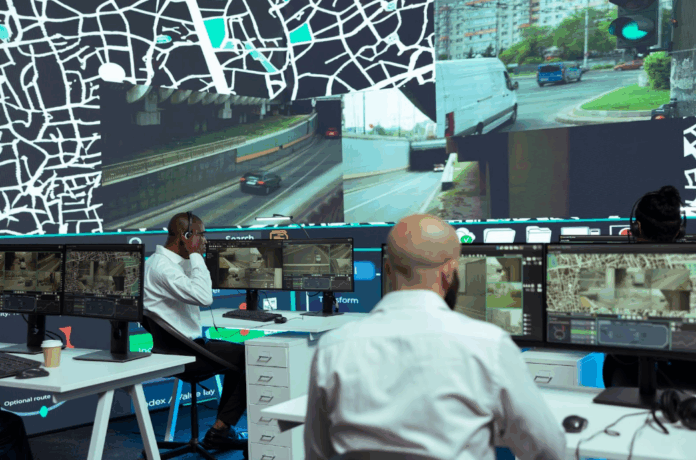
Intrusion attempts, suspicious behavior and workplace accidents can be detected by cameras, regardless of whether a human is physically sitting behind the monitor. It can then send an alarm, including a snippet of footage and information about the event, enabling early intervention while freeing up time for patrols.
- Remote access
Managers and team members can view live feeds and respond to incidents from any secure device. This can be used by retail security to verify deliveries or investigate the authenticity of alarms without being physically present on site. For large, distributed sites, such as Pakenham’s industrial estates, it means teams can be more flexible and monitor multiple sites simultaneously.
- Video-supported access controls
Entry points can be further secured with smart readers that respond to custom credentials, such as keys or mobile devices, helping protect sites from unauthorised access. These readers can be augmented with video, allowing teams to identify whether the credential matches the user.
- Faster investigations
When Australian police are provided with clear footage in a timely manner, their clearance rate improves by 20%. Smart dashboards automatically sort and tag footage, making retrieval quicker and investigations more efficient.
Perhaps most importantly for Pakenham, these systems are designed to scale. Growth introduces new vulnerabilities to retail and industrial sites, but when security can easily be adapted to cover new grounds and stores without disruption, your team and grounds benefit from consistent protection.
Mitigation through optimisation
Central to the appeal of these integrated systems is their ability to provide a more detailed image of proceedings, no matter where security staff are. Whether someone is breaking into a store after hours, trying to steal a vehicle from a site car park, or a worker has fallen while retrieving a box, AI cameras make sure the right people know.
As recruitment across security, retail and industrial industries stalls, these measures help ensure fast-developing corridors like Cardina can continue to grow, bringing jobs and opportunities to communities like Pakenham.